
Your doctor has prescribed neuronavigated transcranial magnetic stimulation (nTMS) brain mapping because you have a brain or spinal cord injury. This page helps you understand the purposes of this test and explains how it is performed.
What is neuronavigated transcranial magnetic stimulation?
Transcranial magnetic stimulation (TMS) is a non-invasive and painless technique for localizing functional areas of the brain. As its name suggests, it stimulates neurons by sending magnetic fields to the skull. It is called neuronavigated because the examination is assisted by a computer with a guidance system that provides a three-dimensional visualization of the brain.
What are the goals of pre-surgical TMS?
Before surgery, its goal is to precisely determine the areas surrounding the lesion that must remain intact. Then, during the procedure, it guides the neurosurgeon, locating the functional brain tissues to be protected. Using this data also reduces the duration of the operation.
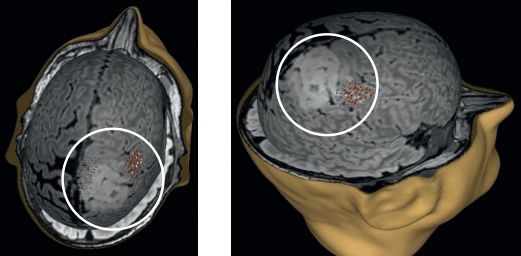
The colored dots show the area responsible for hand motor skills close to the lesion to be removed.
What are “functional areas” of the brain?
The brain is an organ composed of nerve cells, neurons, capable of receiving, processing, and responding to information from the entire body. The regions responsible for a specific function, such as vision, memory, and emotions, are called "functional areas." Some are located on the surface of the brain, such as motor skills, while others, such as language, are more extensive.
Examination procedure
Preparation
Exam
The TMS technician emits brief magnetic fields using an electromagnet that he or she moves over your scalp. You will then feel slight pressure where the device is positioned and possibly muscle contractions in the stimulated limbs. A mapping session generally lasts 60 minutes for motor assessment and longer for speech examination.
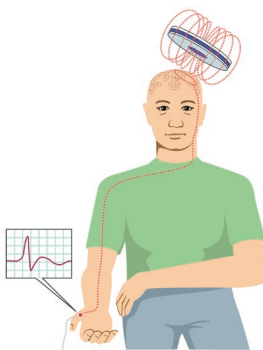 The device placed on your head emits a brief magnetic field in a part of your brain. It generates a weak electrical current that stimulates the muscle corresponding to the activated area of the brain. An electrode placed on the muscle in question (located here on the hand) captures the muscle activity produced.
Language and vision assessment
If your injury is close to areas that may involve language or vision, the TMS technician continues the motor examination by searching for the location of the language or visual network. By sending magnetic stimulations, the principle is to disrupt language during a picture naming task, or vision during a target detection test.
Contre-indications
Due to the intense, brief magnetic fields, the examination cannot be performed if you are pregnant or wearing a metallic object such as:
- an aneurysm clip,
- an implantable brain stimulator,
- brain activity monitoring electrodes,
- cochlear implants,
- a pacemaker, or an implantable defibrillator.
Risks and side effects
Despite all precautions, certain complications may occur:
- Headaches: Uncommon, they are usually described as mild, most often as unpleasant sensations on the scalp.
- Skin irritation at the site of the electrodes: Very low risk.
- Temporary changes in hearing due to the "click" produced when the brief magnetic field is transmitted: Risk almost nonexistent when wearing earplugs. These are offered at the beginning of the examination.
- Epileptic seizures (convulsions) due to electrical stimulation: Rare, the risk is estimated at 0.1% (1 in 1,000 patients) in routine clinical use.
Download the brochure in PDF format
Transcranial magnetic stimulation mapping
Practical information
Contact secretariat
Phone: +41(0)22 372 82 24
Billing
Brain mapping by neuronavigated transcranial magnetic stimulation is reimbursed in the basic health insurance benefits (LAMal), less the deductible and the contribution (10% of the costs at your expense).
Address Neurosurgery Department
Jean-Louis Prévost Building (2nd floor)
Rue Gabrielle-Perret-Gentil 4, 1205 Geneva
Access
Buses 1, 5, and 7, stop "Hôpital"
Léman Express, stop "Genève-Champel"
Parkings
H-Cluse and H-Lombard
LEARN MORE: The Neurosurgery Department specializes in other brain surgery procedures, including neurosurgery for tumors, epilepsy, pituitary gland disorders, hydrocephalus, functional disorders, and traumatic brain injuries. The department also offers advanced techniques such as transcranial magnetic stimulation brain mapping.