
Lumbar Anatomy
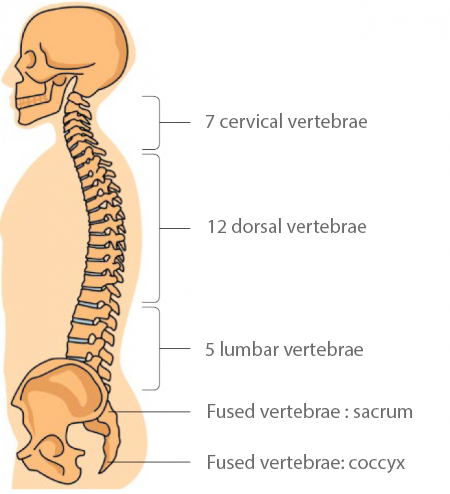
The lumbar spine corresponds to the lower part of the vertebral column, commonly referred to as the lower back. It consists of five vertebrae separated by intervertebral discs. The lumbar vertebrae form a canal through which the spinal cord passes. Spinal nerves, which carry nerve signals between the legs and the brain, exit between the vertebrae on each side.
What is spondylodesis ?
Spondylodesis is the fusion of two or more vertebrae.
What are the indications ?
A vertebral lesion, whether degenerative, traumatic, or infectious, may be an indication for spondylodesis. Your particular situation should be diagnosed and discussed with your doctor.
What is the goal ?
To reduce pain and maintain proper alignment of your spine.
What does the procedure involve ?
The procedure aims to :
- Stabilize the vertebrae using a system of screws and rods, usually made of titanium
- Achieve fusion of certain vertebrae to reduce movement between them using a bone graft (natural or synthetic), or with disc cages (a prosthesis also called arthrodesis that replaces the disc and maintains spacing between vertebrae)
The neurosurgeon determines the number of vertebrae to be fused and selects the technique best suited to your case. Depending on the vertebrae involved (lumbar or cervical), one or more incisions, called “surgical approaches,” are made :
- On the abdomen or chest (“anterior” approach)
- On the back (“posterior” approach)
- On the side (“lateral” approach)
The procedure is performed under general anesthesia.
Is the procedure effective?
In 90% of cases, it relieves arm pain within a few days and promotes recovery. However, in some cases, neck pain, arm weakness, or tingling may persist.
What are the possible complications ?
Possible complications include :
- Pain, limb weakness, or tingling may persist temporarily in less than 20% of cases. These symptoms are usually transient.
- Bone graft may not fuse properly with the vertebrae in 5% of cases (pseudoarthrosis). A second surgery may be needed if the lack of fusion causes persistent pain.
- Infection at the surgical site in 3–5% of cases. Usually, local treatment or antibiotics are sufficient. Rarely, reoperation may be needed to drain an abscess or remove the fixation hardware (screws, plates).
- Hemorrhage requiring a blood transfusion may occur in less than 1% of cases.
- Despite the use of a surgical microscope, nerve injury is still possible, occurring in less than 1% of cases. This may lead to reduced strength or sensation in the lower limbs.
- A hematoma may form at the surgical site in less than 1% of cases. It resolves without treatment in 80% of cases. Reoperation is rarely necessary.
- Injury to abdominal organs or major blood vessels (aorta, vena cava) may occur in less than 1% of cases, especially with lateral or anterior approaches.