Adresse

Rue Gabrielle-Perret-Gentil 4
1205 Geneva
Switzerland

Pr. Isabella Eckerle
Professor
Isabella Eckerle
Physician in charge of the Centre
Professor
Laurent Kaiser
Head of division
Pauline Vetter
Dre
Pauline Vetter
Médecin adjointe, Directrice adjointe du Centre des maladies virales émergentes

Mpox

On 14 August 2024, the World Health Organization (WHO) declared the current situation regarding the mpox virus to be a Public Health Emergency of International Concern (PHEIC). (The original declaration can be consulted at the following address: https://www.who.int/news/item/14-08-2024-who-director-general-declares-mpox-outbreak-a-public-health-emergency-of-international-concern).

Mpox is not a new virus. It has been known to infect humans since the 1970s. It was previously referred to as monkeypox, because monkeys were accidentally infected, and the name was recently changed to ‘mpox’. The natural reservoir of the virus is not monkeys, but rodents endemic to West, Central and East Africa. In these regions, there has been an increase in cases of mpox since vaccination against human smallpox ceased in the 1980s, a trend that has become even more marked since the global epidemic of 2022.

It was the sharp increase in the number of cases reported in the Democratic Republic of Congo (DRC) and a growing number of previously unaffected neighbouring countries, and the emergence of a new clade of the virus (a new strain that has evolved), called Clade Ib, that prompted the PHEIC declaration. Current challenges in the region include a lack of access to diagnostic tests, vaccines and treatments. The WHO and other partners are working with countries and manufacturers to address this need and bring the epidemic under control.

Currently, several epidemics caused by different strains are underway simultaneously in many countries, with distinct modes of transmission and levels of risk. There are still uncertainties regarding the case-fatality rate and morbidity, as well as the transmissibility of the different strains of virus, given the paucity of existing data on mpox and on the current epidemic in East Africa.

The overall risk to the general public is currently considered low by the ECDC for the EU/EEA (https://www.ecdc.europa.eu/en/publications-data/risk-assessment-mpox-epidemic-monkeypox-virus-clade-i-africa). It is likely that cases will be diagnosed in Switzerland and Europe in the coming weeks.

Our Center is actively engaged in the diagnostic validation of mpox tests with our partner FIND and as part of our activities as a WHO collaborating center.

Our reference laboratory, CRIVE, is able to test samples in case of clinical suspicion.

Additionally, clinical studies on mpox are currently underway at HUG.

Below is a brief summary of the epidemiological situation, as well as the case definition and contact persons at HUG in case of suspicion. Given the clinical presentation, the majority of patients consult as outpatients. More detailed information on the disease, diagnosis (sample collection) is available below.
Epidemiology

La variole simienne (anciennement variole du singe) ou orthopoxvirose simienne (virus à ADN) est causée par un virus proche de celui de la variole humaine. Cette zoonose est présente en Afrique centrale et de l'Ouest, et les petits mammifères endémiques de ces régions en sont probablement le réservoir. Elle a été identifiée pour la première fois en 1958 chez un singe infecté, ce qui lui a donné son nom initial, bien que le singe, comme l'homme, ne soit qu'un hôte accidentel. Le premier cas humain a été décrit en 1970 chez un enfant en République démocratique du Congo (RDC). Des cas confirmés et des épidémies surviennent régulièrement en Afrique subsaharienne. Le contact avec le milieu naturel est un facteur de risque.

Au cours des 5 à 10 dernières années, le nombre de cas a augmenté régulièrement en Afrique centrale et de l'Ouest, avec une accélération depuis les épidémies au Nigéria en 2017-2018 et dans le monde entier depuis 2022 (clade IIb) et l'émergence d'un nouveau clade (clade Ib) dans l'est de la RDC en 2024, ce qui a conduit l'OMS à déclarer une urgence de santé publique de portée internationale (USPPI), d'abord le 23 juillet 2022, puis plus récemment le 14 août 2024.

En 2022, une urgence de santé publique de portée internationale (USPPI) a été déclarée suite à l'identification d'une épidémie mondiale d'un nouveau clade II, le clade IIb, touchant principalement les hommes ayant des rapports sexuels avec des hommes et/ou des partenaires sexuels multiples. Cette épidémie a été maîtrisée grâce à la vaccination et aux mesures de santé publique mises en œuvre en dehors des zones endémiques, mais le virus continue de circuler à faible niveau dans le monde entier.

L’USPPI> PHEIC du 14 août est liée à l’émergence du nouveau clade Ib, à sa propagation rapide dans l’est de la RDC avec des cas signalés dans les pays voisins (Burundi, Rwanda, Ouganda et Kenya) et à l’augmentation du nombre de cas cliniques dans les régions endémiques de la RDC (clade Ia).

Il existe actuellement 3 souches principales du virus en circulation :

  • Clade Ia en Afrique centrale
  • Clade Ib : est de la RDC et pays voisins (Ouganda, Kenya, Burundi et Rwanda)
  • Clade II : Afrique de l’Ouest et épidémie mondiale de 2022 hors d’Afrique (clade IIb).

Le virus se transmet par contact direct (par exemple, avec une peau ou des muqueuses lésées) avec les lésions ou les sécrétions de personnes ou d'animaux infectés. La transmission se fait principalement par :

  • Transmission zoonotique : (en particulier le clade Ia)
  • Contact étroit prolongé, sexuel ou non sexuel (principalement Clade Ib et Clade IIb)
  • Transmission de la mère à l'enfant pendant la grossesse (avec un risque important de décès fœtal).

La transmission par contact avec des objets contaminés (par exemple, du linge) est possible, de même que la transmission par gouttelettes de salive infectée en cas de contact prolongé face à face ou par lésions oropharyngées. Il convient de noter qu'à l'heure actuelle, aucune donnée épidémiologique ne permet de conclure à une transmission généralisée du virus par voie respiratoire.

Par précaution, les mesures de protection sont AIR et CONTACT PLUS (voir mesures de vigilance ).

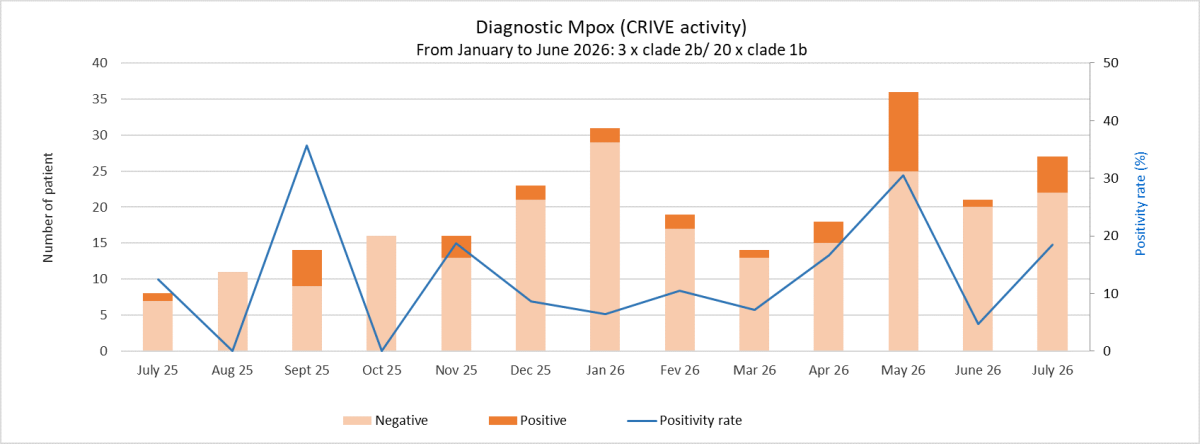
Statistique d'activité Mpox pour fin novembre 2025:


Statistique d'activité Mpox nov 2025.


Clinical presentation

See ‘Case definition’ document.

After an incubation period of one to 2 weeks (21 days maximum), the virus usually causes a febrile state, with adenopathy (cervical, inguinal), followed within 1-2 days by a cutaneous and/or mucosal rash, initially macular and then evolving into vesicles/pustules in the mouth, on the face, trunk and then towards the extremities (including the palms of the hands and soles of the feet). See ‘mpox lesion atlas’.

The number of lesions can vary greatly, as can their distribution on the body (sometimes a disseminated eruption, or, in the case of sexual contact, limited to the genitals). Lesions usually heal spontaneously within 2 to 3 weeks.

The main complications are bacterial superinfections (skin, ENT, sepsis, etc.), foetal death in utero or spontaneous abortion in pregnant women, and more rarely, disseminated forms with encephalitis and local complications depending on the location of the lesions.

An infected person is contagious from the appearance of the first symptoms until the end of the rash, i.e. until the last scabs on the skin have fallen off.

Diagnostic

If there is any suspicion, the Emerging Viral Infections Reference Centre (CRIVE) has a PCR that can be used to make the diagnosis (smear of skin lesions sent to the laboratory in a viral transport medium). To send us a sample, please follow the instructions HERE. Throat swabs can also be taken from suspected patients before lesions appear.

Suspicions and confirmations should be sent to the CRIVE as category B UN 3373.

Since 1 March 2023, PCR for mpox has been invoiced and covered by compulsory health insurance. The deductible and co-payments apply.

There is no routine serology available.

If you have any suspicions, you can contact the Infectious Diseases consultation on 022 372 98 03 (This number is reserved exclusively for healthcare professionals, Monday to Friday, 8.30am to 6.30pm). The HIV Unit hotline (34 656) is the point of contact for all patients treated in the Unit, whether for HIV infection or for taking PreP. Outside these hours, you can contact the HUG central office.

If the diagnosis is confirmed, the disease must be reported within 24 hours to the cantonal doctor (for Geneva:mc-ge@hin.ch) and to the FOPH, by both the clinician and the laboratory.

Treatment

Most infections heal spontaneously. There is therefore generally no need for specific treatment. Treatment consists of relieving symptoms and preventing complications (e.g. bacterial superinfection).

Several antivirals have shown an in vitro or in vivo effect in animals infected with the mpox virus (see review here). There are few data available for humans.
The HUG is participating in an international double-blind randomised controlled trial testing an antiviral, tecovirimat, in the treatment of mpox infection (UNITY). Tecovirimat is also available outside this study for patients with severe disease or at risk of severe disease.

In the DRC, the initial results of a clinical trial testing tecovirimat did not show that the treatment reduced the healing time of cutaneous and/or mucosal lesions. However, given the differences between the populations affected by the two clades, with their different clinical forms and care environments, the UNITY study is continuing in Argentina, Brazil and Switzerland, as is a similar study, the STOMP study, in the United States.  

The Swiss Society of Infectiology (SSI), in collaboration with the Federal Commission for Sexual Health, is drawing up management recommendations, which will be regularly updated. By 20.08.2024, treatment should be offered to :

  • Patients at high risk of developing severe disease: immunosuppressed patients, pregnant women and children under 8 years of age
  • Patients with severe (more than 100 lesions) or very severe (more than 250 lesions) disease or functional disability
  • Patients hospitalised with organ dysfunction (encephalitis, myocarditis, sepsis, haemorrhagic lesions, etc.)

See document ‘Criteria for receiving treatment with tecovirimat either in the open-label arm of the UNITY study or as compassionate access outside the study’.

Vaccination

The vaccine available (Jynneos®, manufactured by Bavarian Nordic) is a third-generation non-replicative live vaccine developed from MVA-BN (Modified Vaccinia Ankara - Bavarian Nordic).  It was originally developed to combat human smallpox and offers cross-protection against mpox. Studies show a better tolerance profile and fewer side effects than first- and second-generation smallpox vaccines. It is considered highly effective in preventing severe forms of mpox, but not necessarily symptomatic infection.

The human smallpox virus was eradicated from the planet in the early 1980s. In Switzerland, people born before 1972 were vaccinated against human smallpox with a vaccine from the generation preceding the current Jynneos vaccine.

Vaccination with Jynneos® consists of 2 doses 1 month apart, with a booster after 2 years. The vaccine was approved by Swissmedic in March 2024.

The Swiss Expert Group on Travel Medicine recommends vaccination against mpox in the following situations (status as at 16 August 2024, will be updated regularly):

People travelling to the east of the Democratic Republic of Congo and Burundi in the event of :

  • Working in a healthcare or laboratory environment
  • Working with animals
  • Planned sexual or other close physical contact

People staying or travelling worldwide in the event of :

  •  Increased risk (e.g. laboratory workers handling the virus, men who have sex with men or trans people with several sexual partners), see Swiss recommendations.

Vaccination is not recommended for people with no risk factors in Switzerland, or for people travelling to other parts of the world (including sub-Saharan Africa).

Another indication for vaccination is exposure to an infected person in a professional or personal context (post-exposure prophylaxis).

If you come into contact with someone at work at the HUG, contact the “Service de santé au travail”.

Vaccination sites :

  • For people with a dense sexual network such as men who have sex with men and transgender people who have male sexual partners and change them regularly, or for people at risk of sexual exposure in endemic or epidemic areas.
  • HIV Unit
    Infectious Diseases Department
    Morier Building, 2nd floor
    Geneva University Hospitals
    Rue Gabrielle-Perret-Gentil 6
    1205 Genève

          Tél. : 022 372 96 17
          Mail : infectiologie.ambulatoire@hcuge.ch

  • Checkpoint Genève
    Rue du Grand-Pré 9
    1202 Genève

          Tél. : 022 906 40 30
          Mail : vaccination.mkp@dialogai.org  et /ou secretariat.checkpoint@dialogai.org
          Site : Checkpoint Genève

  • Geneva Health Group (Groupe santé Genève)
    Rue du Grand-Pré 9
    1202 Genève

          Tel : 022 700 15 00
          Site : https://groupesantegeneve.ch

  • For people at risk in their professional environment and those travelling to high-risk regions or where sexual promiscuity is a possibility.
  • Department of Tropical and Humanitarian Medicine
    Geneva University Hospitals
    Morier Building, 3rd floor
    Rue Gabrielle-Perret-Gentil 6
    1205 Geneva

    Tel: 022 372 96 15
    Mail : info.medint@hug.ch


Latest update 26.08.2024

Last update : 02/12/2025

News & Events