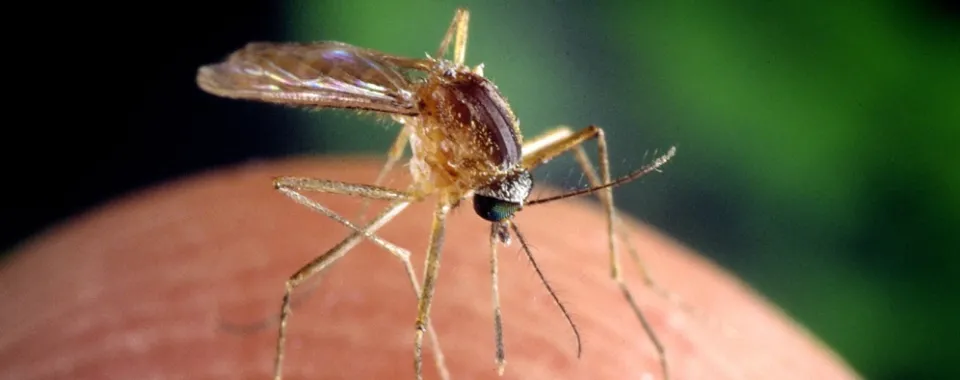
A major risk factor for severe forms of West Nile virus infection has been identified in an international clinical study coordinated, among others, by the University Hospitals of Geneva (HUG) and Rockefeller University in New York. The virus, which is mainly transmitted by mosquitoes, has become a public health concern after its recent arrival in Europe and Switzerland. It causes encephalitis, i.e. a serious inflammation of the brain, in 0.5% of cases. Encephalitis can be fatal. The study shows that the risk of developing encephalitis in individuals carrying certain auto-antibodies is up to 2,000 times higher than that in individuals not carrying them. Published in the Journal of Human Immunity, the study is a source of hope for targeted screening and prevention strategies.
West Nile virus, once confined to tropical areas, is gradually spreading in Europe and Switzerland due to global warming. ‘We are now seeing the virus become established in northern Italy, around the Po Valley. It is also present in Ticino,’ warns Prof Alessandro Borghesi, the study’s principal investigator, Staff Physician in the Division of Neonatal and Pediatric Intensive Care at HUG and Visiting Professor in the Department of Pediatrics, Gynecology and Obstetrics at the University of Geneva (UNIGE).
In about 80% of cases, the infection is asymptomatic, in about 20% of cases it evolves into flulike symptoms that do not require hospitalisation, and in about 0.5% of cases it leads to a serious illness. These severe forms are characterised by encephalitis that lead to death in one in five patients or to significant neurological sequelae in about half of the survivors. As there are currently no specific treatments, all patients with severe forms need hospitalisation, most often intensive care to support their vital functions.
According to Prof Alessandro Borghesi, even if these severe forms remain rare, they are enough to saturate care centres during outbreaks. ‘This was the case in Italy, where more than 2,000 cases of encephalitis associated with the virus were recorded between 2018 and 2022. In Israel, which has faced the largest known outbreak to date, several hundred people were admitted to intensive care in 2024,’ he explains. Faced with this reality and the lack of treatments, this study aims to better identify people at risk of developing severe forms in order to implement preventive measures.
When immunity fights against itself
Type I interferons are molecules produced very early by our body to control viral infections. In some otherwise healthy individuals, however, autoimmune antibodies – called anti-interferon antibodies – circulate in the blood and neutralise these immune system messengers. ‘These people live without knowing that they are vulnerable in an invisible way. They can cope with most infections, but if they are infected with a new virus, such as the West Nile virus, this vulnerability becomes apparent,’ explains Professor Alessandro Borghesi.
The results confirm that anti-interferon antibodies are absent in asymptomatic or mildly affected individuals, but present in 40% of people hospitalised with encephalitis. The presence of this immune molecule increases the risk of developing encephalitis by a factor of 20 to 2000.
In a previous study, the researcher and his team had identified these autoantibodies as a risk factor for developing encephalitis following infection with the West Nile virus. The next step was to verify these results on a larger scale. In order to do this, Professor Alessandro Borghesi and his team analysed 13 independent international cohorts of people infected with the West Nile virus between 2022 and 2024, in particular in Italy, Israel and the United States.
Towards targeted screening and preventive measures
This discovery opens up concrete possibilities. Screening could be considered, particularly in people over 65, who are at greater risk of developing severe forms. ‘This would make it possible to identify people at risk and adapt preventive measures or, if a vaccine is developed one day, vaccination,’ explains Professor Alessandro Borghesi. Furthermore, this discovery paves the way for a better understanding of severe forms resulting from other viruses, such as tick-borne encephalitis, COVID-19 or even influenza, which could involve the same mechanism.