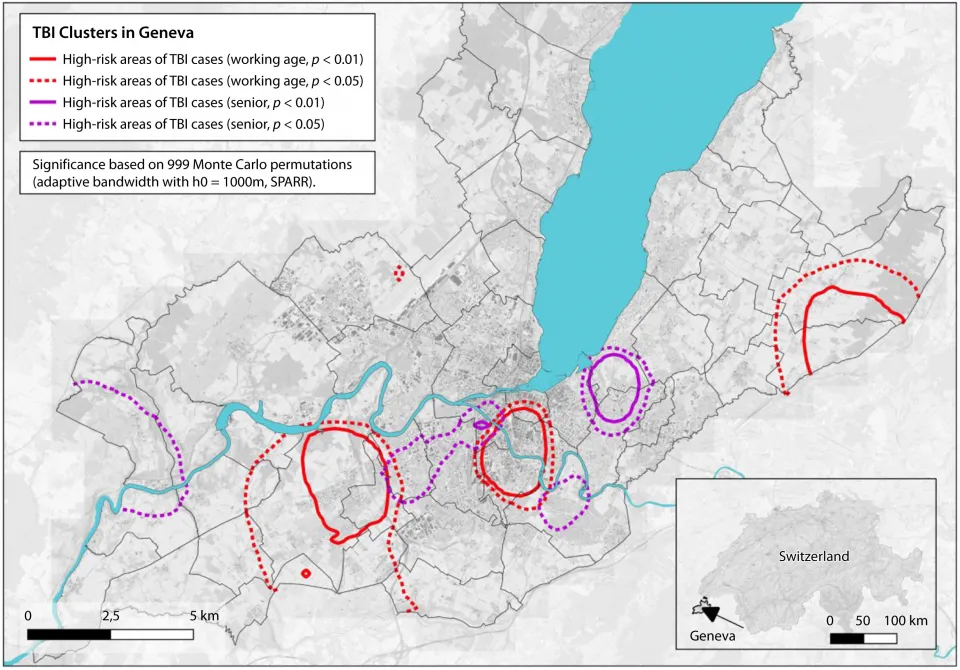
- Four significant spatial clusters were identified
Among adults aged 60 years and older, traumatic brain injuries were concentrated in central Geneva and the Dardagny region, areas characterized by a high proportion of older residents and the presence of long-term care facilities. For working-age adults (18–59 years), clusters were primarily located in the western and southern parts of the canton. These distributions did not overlap, highlighting the existence of age-specific risk environments.
- Temporal patterns vary by age group
Hospitalizations among older adults peaked in autumn and at the beginning of the week, a pattern consistent with the influence of environmental factors such as reduced daylight or slippery surfaces, as well as certain lifestyle habits. In contrast, hospitalizations among working-age adults were distributed more evenly throughout the week.
- Ten distinct patient profiles were identified
By combining demographic, clinical, and socioeconomic data, the researchers identified different trajectories, ranging from older men living alone who experienced longer hospital stays and were less likely to return directly home, to women living in suburban areas with high educational attainment but facing greater socioeconomic vulnerability. Overall, the findings suggest that outcomes following a traumatic brain injury are influenced not only by the characteristics of the injury itself, but also by the interaction between age, social conditions, and living environment.
This study demonstrates how routinely collected hospital data can provide a clearer understanding of the spatial and temporal distribution of traumatic brain injury risk. By identifying locations and periods with the highest incidence, such analyses can help guide prevention strategies, enhance the safety of older adults, adapt healthcare services, and support more equitable public health planning.
The study also underscores the importance of an interdisciplinary approach at the intersection of epidemiology, neuroscience, and neuropsychology. Integrating clinical, spatial, and temporal data opens the door to new approaches in neurogeography and neuroepidemiology, “at the heart of the NeuroGIRAPH approach,” as Giannina Iannotti points out.