Press release Two 2026 Leenaards Science Awards Presented: One to Reduce the Impact of Hepatitis E Virus, the Other to Restore Cognitive Functions.
NEARLY 1.4 MILLION FRANCS FOR BIOMEDICAL RESEARCH IN THE LAKE LEMAN REGION
Two 2026 Leenaards Scientific Awards Presented: One to Reduce the Impact of the Hepatitis E Virus, the Other to Restore Cognitive Functions
Two research groups in the Lake Geneva region have been selected for the 2026 Leenaards Science Prize, which comes with a total of nearly CHF 1.4 million in award money. One aims to reduce the impact of the hepatitis E virus, while the other is working to restore lost cognitive function.
One of the research groups, led by Prof. Isabella Eckerle, a clinical virologist at Geneva University Hospitals (HUG) and the University of Geneva (UNIGE), is developing an effective treatment for hepatitis E that can prevent the genotype 1 virus from replicating and spreading during an epidemic. Hepatitis E causes the death of at least 44,000 people in Africa and Asia every year, including pregnant women, yet relatively few studies have been conducted on the virus.
The second research group is led by Elena Beanato, who holds a PhD in translational neuroscience. Her team at HUG is exploring a new non-invasive approach for restoring cognitive function – and especially spatial orientation capabilities – after a head trauma and in cases of epilepsy. Their approach uses electric fields to carry out transcranial deep brain stimulation, eliminating the need for invasive surgery.
These two research teams, along with last year’s award winners (2025 Leenaards Science Prize), will be honored at the Rendez-vous Health & Science event on Wednesday, 28 October, at the University of Lausanne. This event is open to the public.
Decoding the hepatitis E virus to counter epidemics
Over 20 million people around the world are infected with hepatitis E every year, leading to at least 44,000 deaths – primarily in Africa and Asia where the genotype 1 virus (HEV-1) spreads through contaminated drinking water, triggering vast epidemics. The mortality rate among pregnant women can reach 25% in regions with poor water-purification and sanitation infrastructure. Despite this heavy toll, relatively little research has been performed on HEV-1, and hepatitis E is still largely under-diagnosed. What’s more, the virus is highly stable in the environment, meaning doctors have few tools for combating it.
“Hepatitis E is one of the hardest diseases to deal with out in the field. Very few actionable solutions are available when an epidemic strikes,” says Prof. Eckerle, head of the Centre for Emerging Viral Diseases at HUG and a professor at the University of Geneva (UNIGE) Faculty of Medicine. She aims to address this problem through one of the two projects selected for the 2026 Leenaards Science Prize.
“Our research group’s hope is to be able to rapidly identify antiviral drug candidates in order to give doctors a treatment they can use during epidemics to help patients with severe forms of the disease,” says Dr. Eckerle a professor at the UNIGE Faculty of Medicine. She is spearheading this project alongside Jérôme Gouttenoire – a professor at the University of Lausanne (UNIL) Faculty of Biology and Medicine (FBM) and head of the Lausanne University Hospital (CHUV) gastroenterology and hepatology department – whose laboratory is conducting fundamental research on hepatitis E – and Dr. Andrew Azman, an epidemiologist at the HUG-UNIGE Centre for Emerging Viral Diseases and UNIGE who works closely with Médecins Sans Frontières (MSF) Switzerland.
A unique collection of samples from a recent epidemic, built with the help of MSF
When a major hepatitis E epidemic broke out in South Sudan in 2022, MSF and the South Sudan Ministry of Health conducted an emergency vaccination campaign. Because this was the first public-health use of the vaccine in Africa, MSF also launched a research study to assess how well the vaccine performed in this population. As part of that work, thousands of blood samples were collected from both infected and vaccinated individuals. Using the remaining samples from this study, Prof. Gouttenoire’s research team at the CHUV achieved a major breakthrough: they successfully created an infectious version of HEV-1 in vitro. “We were able to introduce the virus’s genetic material into human cells so that we could cultivate it in a laboratory,” says Prof. Gouttenoire. “That had never been done before with this genotype after the virus’s genome had been replicated.” This breakthrough opens up promising new avenues of research. Scientists will now be able to analyze the exact immune-system response after vaccination or infection with the virus, determine how effective the resulting antibodies are, and run large-scale tests on drugs that could potentially stop the virus from replicating.
This project clearly illustrates the benefits of a translational approach, as it combines fundamental research with data collected during a recent epidemic. “Our project could enable healthcare teams to respond more effectively to hepatitis E outbreaks and reduce the impact of a virus that’s still largely overlooked by the international public health and research communities,” says Dr. Azman.
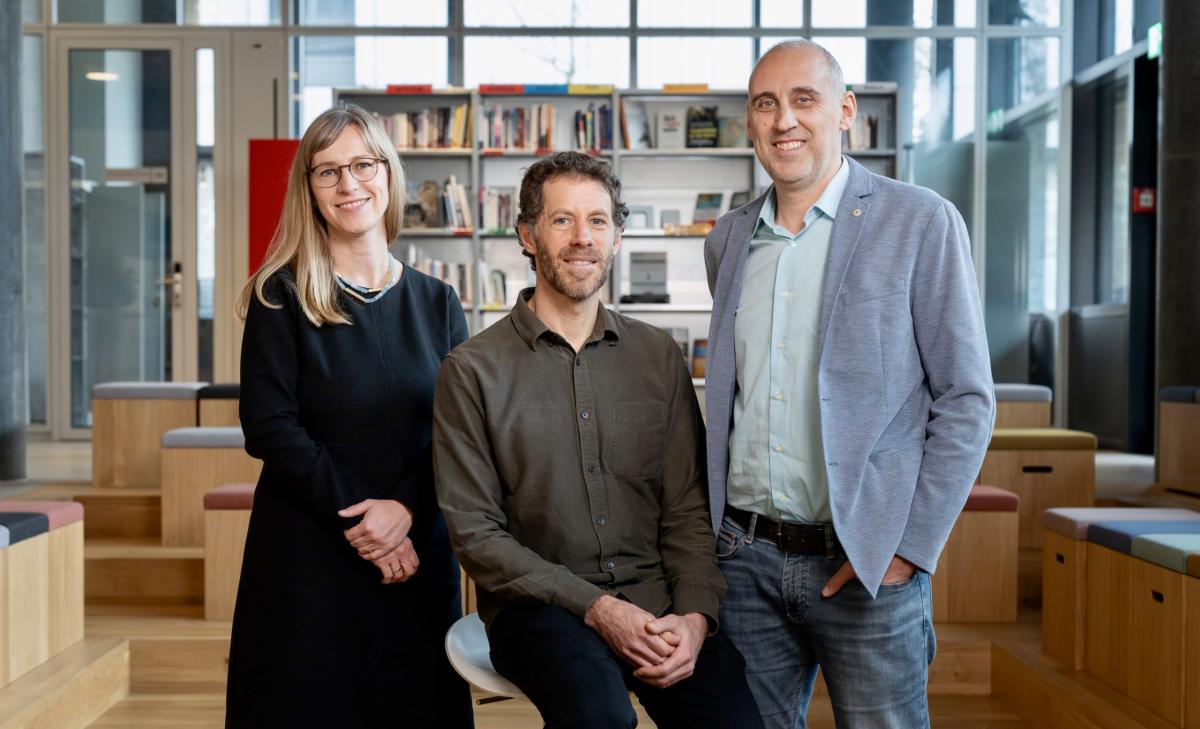
The research team is led by Prof. Isabella Eckerle (HUG / UNIGE, left), along with Dr. Andrew Azman (HUG / UNIGE, center) and Prof. Jérôme Gouttenoire (FBM-UNIL / CHUV, right).
© Noxedie
LEARN MORE: Understanding the hepatitis E virus to combat outbreaks
Press release in French : Follow tis link
![]()