- Homepage
- The Centre
- Research & innovation
- Virtual Medicine Center
- Outpatient clinic for brain and mental health
Neurocentre
Neurocentre
Neurocentre
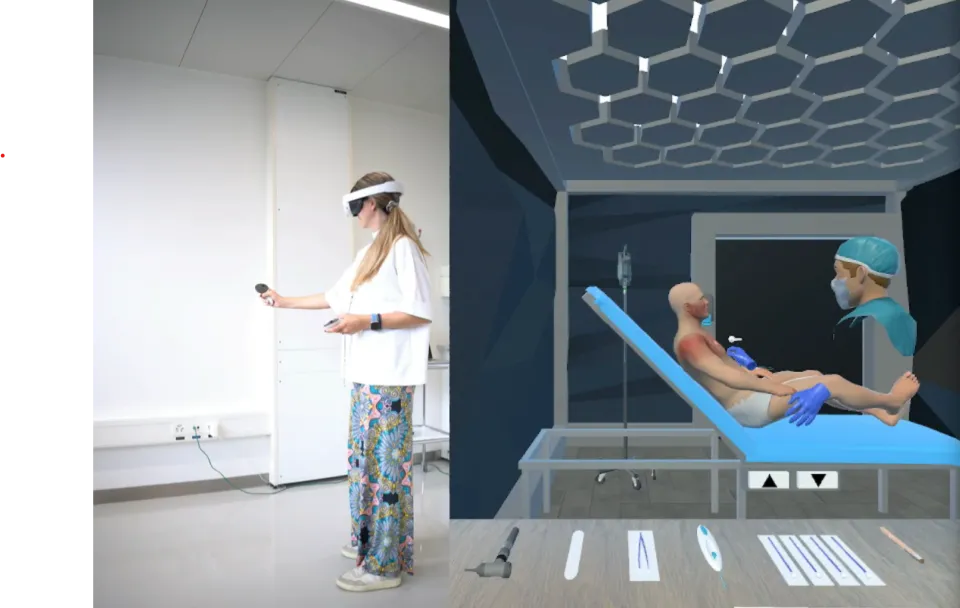
A recent study explores whether immersive virtual reality (VR) can be used to assess medical students in a way that compares with traditional Objective Structured Clinical Examinations (OSCEs). The work is the result of a close collaboration between the Geneva University Hospitals (HUG), Inselspital Bern, and the Institute for Medical Learning (IML), which oversees OSCE examinations at the national level in Switzerland, funded by the VMC's Innosuisse project.
The study was led by Andrea Neher, who coordinated and ran the full experimental protocol, with Mathias Delahaye playing a central role as the lead engineer, responsible for the technical development and deployment of the VR examination environment. Fifth-year medical students completed an emergency medicine OSCE station both in person and in VR, using identical content. Results showed comparable perceived workload, realism, and fairness, with positive usability and acceptance of the VR format. While performance scores were lower in VR—particularly for medical content and communication—the study demonstrates that VR-based clinical assessment is technically feasible and well accepted by learners.
These findings highlight the value of cross-hospital and interdisciplinary collaboration in exploring new approaches to medical assessment and open promising perspectives for the future of standardized, scalable clinical examinations.