- Homepage
- The Centre
- Research & innovation
- Virtual Medicine Center
- Outpatient clinic for brain and mental health
Neurocentre
Neurocentre
Neurocentre
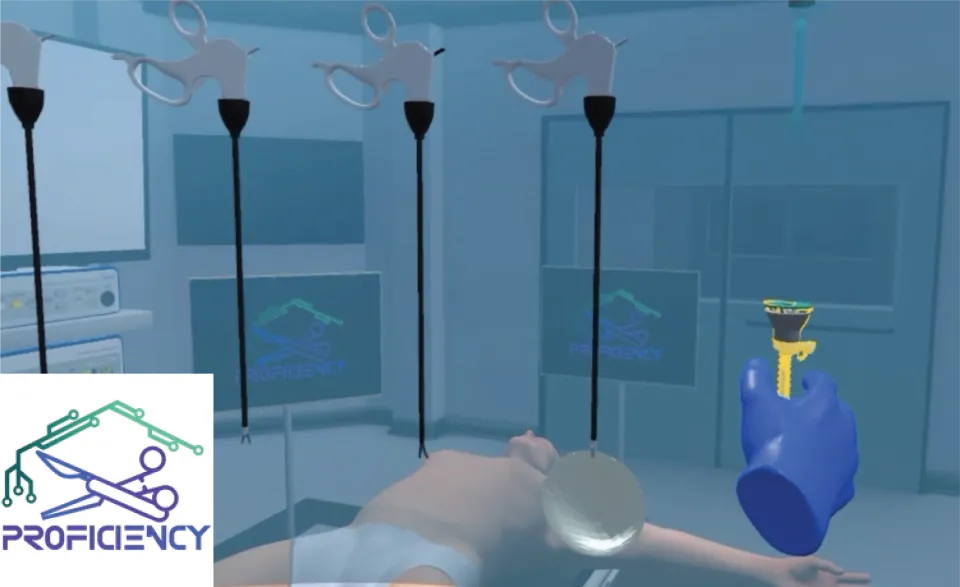
How do you help medical students prepare for the operating room — before they ever set foot in one?
At the Virtual Medicine Center (HUG), this question guided one of our most recent projects: creating a VR simulation to train students in preparing the operating room (OR) for a Laparoscopic Cholecystectomy.
The project was initiated by Prof. Hahnloser (CHUV) as part of the Innosuisse PROficiency Flagship Project and presented at the Swiss College of Surgeons Annual Meeting 2025 at EPFL’s SwissTech Convention Center in Lausanne.
Why Spatial Training Matters
Preparing an OR is more than just checking items off a list — it’s about understanding where each piece of equipment belongs and how to move safely and efficiently through a complex space.
These are spatial skills, and VR is uniquely suited to developing them.
Unlike 2D diagrams or text-based instructions, VR lets students see, reach, and interact with the OR layout in 3D, just as they will during real procedures.
We believe you don’t need long or complex simulations to make VR powerful — especially for training these fundamental spatial tasks.
Two Platforms, One Experience
While immersion is essential, so is accessibility.
Sometimes, students want to rehearse in the headset, and sometimes they just want to review on the bus.
To make this possible, we built two complementary tools using ORamaVR’s MAGES SDK:
This combination allowed us to rapidly prototype and deliver both tools in time for the Swiss College of Surgeons Annual Meeting 2025, where they were showcased to the surgical education community.
Part of the PROficiency Project
This work is part of PROficiency, an Innosuisse Flagship project that brings together academic and industry partners across Switzerland to rethink how surgical training is delivered.
Our shared goal is to create training solutions that are standardized, efficient, and engaging for the next generation of surgeons.
Looking Ahead
This project showed us how VR and mobile tools can complement each other — offering both deep spatial learningand everyday accessibility.
We’re excited to keep exploring new ways to make surgical education immersive, flexible, and scalable — and we’re grateful to all the collaborators who helped make this project possible.